
It’s the start of the year: you’re stuffed full of Holiday meals and treats, you’ve spoiled your friends and family, and you’ve (hopefully) caught a few extra Zs.
For e-commerce businesses, Black Friday, the Holidays, and Boxing Week are in the books. Hopefully, it was a resounding success, especially if you followed our comprehensive guide. The earlier you can start, the better equipped you’ll be for success. For most digital marketing specialists, January will be a time for reflection, discussion, and planning to set you up for a successful year of execution.
TL;DR Version
- Reflection
- Post-Mortem: SWOT Your Performance
- Deep Dive to Unearth Hidden Gems & Missed Opportunities
- Discussion & Collaboration
- Align on company objectives
- Schedule key moments, challenging the status quo
- Planning
- Forecast to understand potential outcomes, budget & resources required, and potential challenges
- Set KPIs to meet company & marketing objectives across the full marketing pipeline
- Build your testing plan
- Execute!
Reflection
Post-Mortem: SWOTing Your Performance
Creating a SWOT (Strengths, Weaknesses, Opportunities, Threats) analysis will help you with your post-mortem on the previous year and the Black Friday period as a whole. Aim to have your takeaways backed by quantitative data and deep dive where able. Here are a few starting questions to explore:
- How did top channels (Paid, Email, Organic, Affiliate, Referral, etc.) perform quarterly, year-over-year?
- Did monthly performance follow historical performance trends?
- Was media spend, such as Google Ads cost, efficiently distributed?
- Are brand impressions growing over time?
- What strategies (new campaign types, ad channels, omnichannel) are available to explore?
- Are there emerging market opportunities (product or location)? How are competitors aligned in the market?
- What external factors might impact your business in the coming year, such as the deprecation of 3rd party cookies and evolving privacy regulations?
With your SWOT done, you’ll have the foundation to guide your upcoming discussion and planning to set digital marketing goals for the year ahead.
Deep Dive: Unearthing Hidden Gems & Missed Opportunities
Work with your team to dive deep into tactics managed during the previous period. A SWOT is typically completed after you’ve reviewed your channel and monthly/quarterly performance. Review your major event post-mortems (you did one after Black Friday, right?), but also review everyday tactics across:
- Top-converting creative formats, ad copy angles, and messaging hooks
- Audience retention and first-to-second purchase velocity
- Product margin contribution across different discount tiers
- Abandoned cart and browse recovery rates during peak traffic
Discussion & Collaboration
Once individual channels and teams have completed their retrospectives, bring cross-functional leads together:
- Align on Company Objectives: Marketing does not operate in a silo. Review top-level inventory forecasts, cash flow requirements, and gross margin expectations before locking in ad spend.
- Schedule Key Moments: Map out product launches, seasonal promotions, and tentpole sales events for the upcoming 12 months.
- Challenge the Status Quo: Which legacy platforms or campaigns are underperforming relative to their budget allocation? Don’t hesitate to reallocate resources toward higher-incrementality channels.
Planning: Forecasting & KPIs
Realistic Forecasting Scenarios
Build out low, medium, and high forecasting models. Ground your projections in historical retention cohorts and blended Marketing Efficiency Ratio (MER) rather than isolated channel ROAS.
Dedicated Key Performance Indicators (KPIs)
Overall sales will likely be the ultimate indicator of success throughout the year; however, that’s not the case for all initiatives. Planning and budgeting for a complete pipeline strategy for awareness, consideration, intent, and retention-based segments will require different measurements for success. Diving into a few examples:
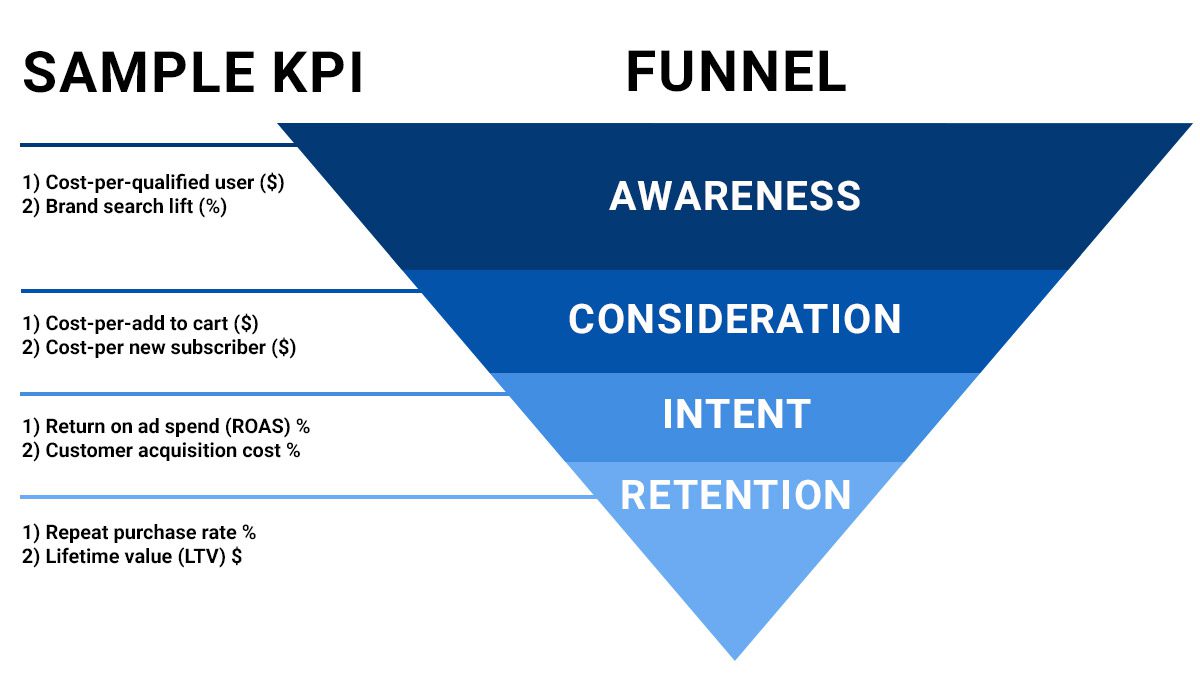
Benchmark your KPIs for overall success and set targets. As the year progresses, it’ll allow for a simplified diagnosis of which portion of the pipeline needs greater attention.
Testing & Tactics: Plan Early & Collaborate
Being proactive and setting a yearly testing plan will benefit your time, resources, and budget deployment. All testing should be SMART goal-based to meet your forecast targets and find efficiencies on your dedicated KPIs. Building your testing calendar at the start of the year provides foundational benefits:
- Showcase your organized improvement efforts to management.
- Allows supporting departments to plan their time & resources more efficiently.
- As data is gathered, strategies can quickly be refocused to target more impactful improvements.
[!TIP] Pro-Tip: Withhold 5% of your media budget for pure exploratory testing. Nine out of ten tests may fail, but the one that works can be rapidly expanded and scaled to transform your bottom line.
Never test anything only once, and never stop experimenting! Aim for conclusive data that accounts for shifting consumer behavior across seasons.
With your reflection, alignment, and planning completed, it’s time to execute. Stay flexible throughout the year, maintain clear communication across teams, and adapt as live data rolls in.