The BFCM Inbox Battle
While fundamentally an American event, Black Friday and Cyber Monday have transformed into a global retail standard. In Canada, this promotional window has been the most important shopping event of the year, officially dethroning Boxing Day back in 2019. Because there’s so many participants, inbox competition has never been fiercer.
The brands that win this promotional period in Canada aren’t the ones with the deepest discounts, they’re the ones that command the inbox. If you treat your holiday email strategy as a series of disconnected, last-minute blasts, your revenue will plummet, your unsubscribes will skyrocket, and your emails will spend their December rotting in spam folders.
We built this guide to pull back the curtain on our exact agency playbook: the precise week-by-week send cadence, the click-driven segmentation tiers, and the automated flows you need live before the chaos hits.
1. The 2026 Week-by-Week Send Calendar
6 Weeks Out (Early October)
List Hygiene & VIP Setup
Before sending a single promotional email, clean your list. Sending BFCM volume to cold addresses destroys deliverability exactly when it matters most.
- Run a sunset campaign to scrub non-responders. Anyone who hasn’t opened or clicked an email in the past 6+ months should receive a single win-back email. Non-responders should be suppressed before November 1.
- Inject BFCM-specific copy and urgency banners into your existing core automations (Welcome, Cart Abandonment). Platforms like Klaviyo and Mailchimp have built-in BFCM flow templates worth checking out.
- Build your VIP segment. Pull customers who have 2 or more orders or an LTV above your defined threshold. They should get a dedicated, earlier track to the promotion.
4 Weeks Out (Late October)
The Warm-Up & Teaser Track
Start building anticipation without revealing your full offer. The goal here is clicks, even a simple “Something big is coming” email that earns high engagement signals to inbox providers that your list is healthy.
- Send 1: The “Something massive is coming” teaser. Push users to a dedicated VIP waitlist or preference center.
- Send 2: The VIP Early-Bird Invite. Offer exclusive access to deals 48 hours before the general public.
2 Weeks Out (First 2 Weeks of November)
The Strategic Offer Reveal
Now you show your hand, but target your messaging.
- Send 3: Full offer revealed exclusively to your engaged segment (clicked in the last 90 days). Subject line formula:
[Number]% off + deadline + exclusive angle. - Send 4: Category-Personalized version. Use dynamic content blocks based on user browsing history.
- Send 5: A dormant win-back track is a softer version of the main offer for 91-180 day inactive contacts. Keep volume low to protect your sender reputation.
Black Friday Week
5–7 Email Sends
This is the week most brands under-send because they fear unsubscribes. High-volume BFCM sends do increase unsubscribes, but they also drive 60–70% of the total BFCM revenue, so, send the emails!
- Monday: Campaign launch email – Full offer + live countdown timer + clear CTA.
- Tuesday: Category spotlight – Highlight your best-performing or highest margin product line.
- Wednesday: Social proof – Aggressive social proof, user-generated content (UGC), and product focus.
- Thursday: Brand-led story or community angle – Softens the sales pitch before the storm.
- Black Friday: The Double-Down – Send a morning launch (6–8 AM) + afternoon reminder to non-openers (2:00 PM). Two sends on the day itself is the standard. Three is acceptable if your list is warm.
- Saturday–Sunday: The Extension (if applicable) – A structured “Due to high demand, we’ve extended…” email track.
Cyber Monday / Week Pivot
Fresh angle, not a repeat
The biggest mistake that brands make in Cyber Week is re-sending the same Black Friday email with “Cyber Monday” in the subject. This kills engagement. Instead, use a genuinely different offer.
- Cyber Monday: Introduce a fresh offer – If Black Friday was a flat percentage off, turn Cyber Monday into a Gift with Purchase (GWP) or a tiered spend bonus.
- Tuesday–Wednesday: The “Last Chance” urgency sequence (if applicable). One email each day with a live countdown. Highest-converting sends of the entire window.
- Post-BFCM: A thank-you and “what’s coming in December” send within 5 days – Protects subscriber relationships and seeds the holiday period.
2. The Four Segmentation Tiers That Drive Revenue
Treating your entire list the same during BFCM is the fastest way to burn it. Here are the four tiers that matter, what to send each, and why.
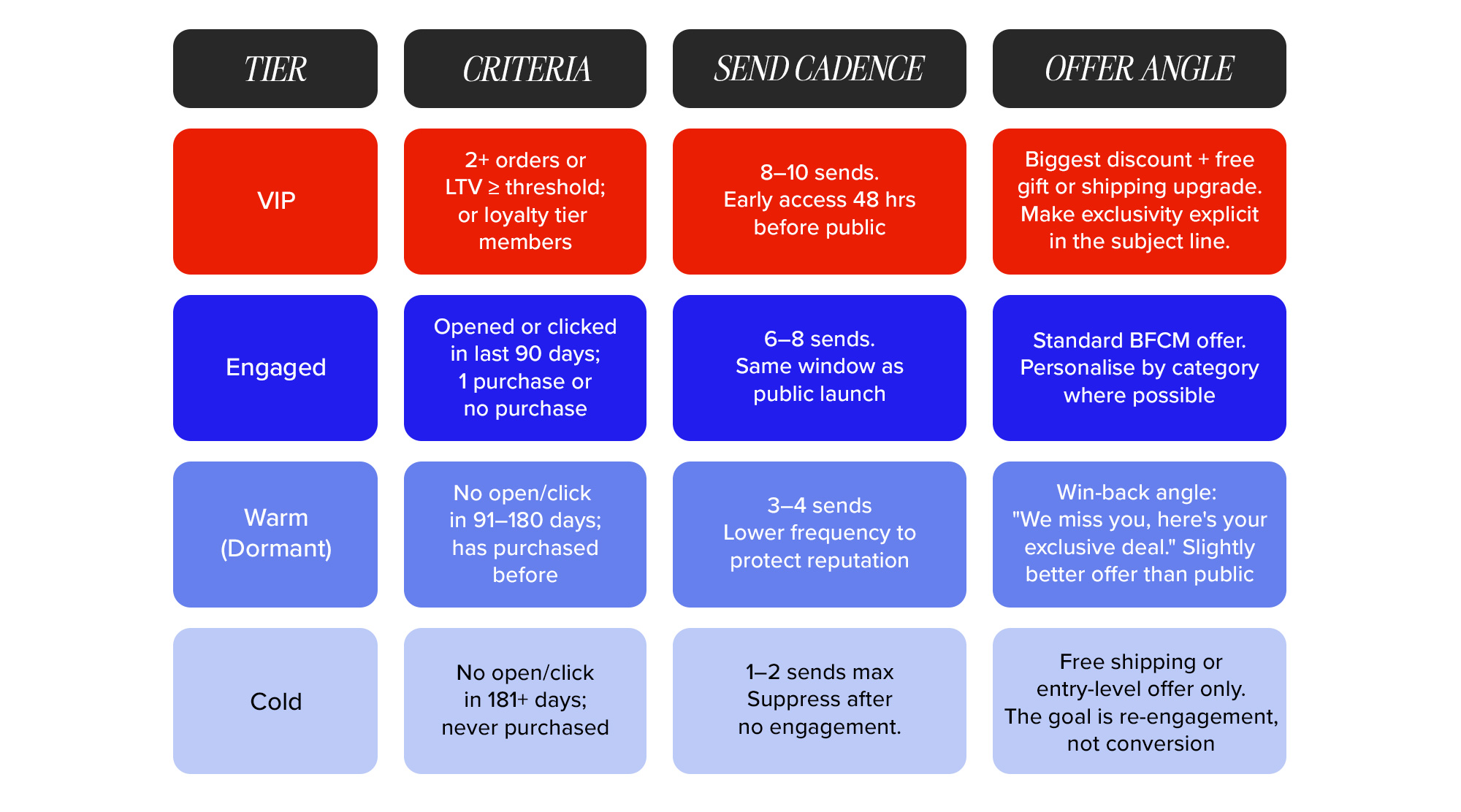
[!TIP] Segmentation tip for 2026 With Apple MPP inflating open rates, build your ‘engaged’ segment on clicks, not opens. A subscriber who clicked anything in the last 90 days is a far more reliable signal than one who ‘opened’ (which may be a machine pre-fetch). If your ESP allows it, create a separate ‘click-engaged’ qualifier.
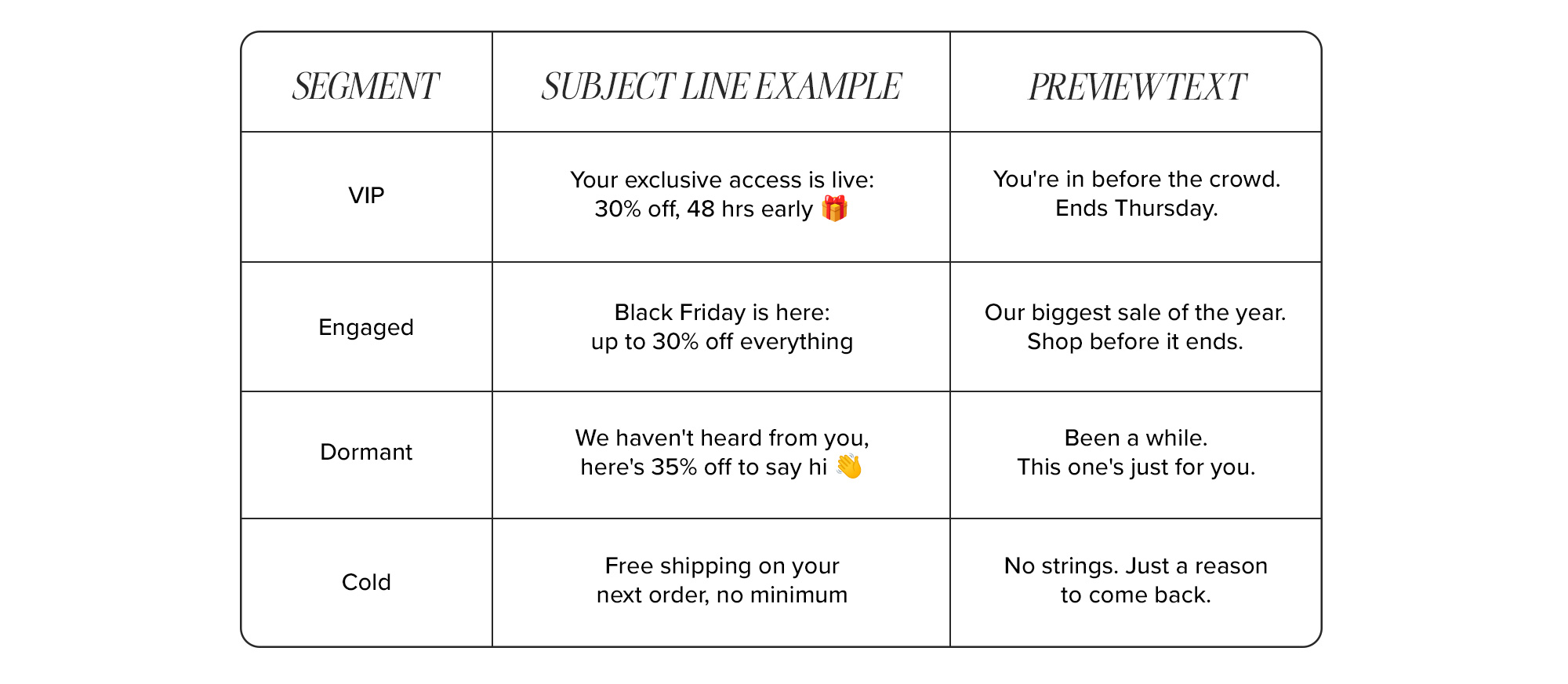
Real Segmentation Examples by Email Type
Bilingual Strategy for Quebec Audiences
For brands with significant Quebec customer bases, a bilingual email strategy is one of the highest-ROI investments you can make before BFCM. French-language emails to Francophone subscribers consistently outperform English-only sends on click rate and conversion, not by a small margin, but often by 20–30%. This is not just about language preference; it is about cultural relevance and the signal it sends that your brand respects and understands its audience.
- Segment by language preference first. Use your ESP’s language field, billing address province, or a preference centre opt-in to identify French-preferred subscribers. Quebec province is a reliable proxy if explicit language data isn’t available.
- Do not machine-translate. Quebec French has a distinct vocabulary, idioms, and a tone that differs from European French. Auto-translated copy reads as generic at best and off-putting at worst. Use a human translator or a native-speaking copywriter for your core BFCM emails.
- Subject line localisation matters most. Even if you can only translate one element, translate the subject line and preview text. These are the highest-leverage words in the entire email.
- CASL compliance is non-negotiable. Canada’s Anti-Spam Legislation requires express or implied consent for commercial emails. BFCM is not a reason to lower your compliance standards; if anything, the increased volume makes clean consent practices even more critical. Review the CASL requirements on the Government of Canada website before scaling your list for the BFCM window.
3. Critical Automations to Optimize Before October 31
While your promotional marketing campaigns get the spotlight, your automated flows are your silent heavy-lifters. Automations generate a disproportionate share of email revenue during BFCM because they reach subscribers at intent-rich moments. Before peak traffic spikes, our team optimizes these core engines:
For a primer on setting these up, Klaviyo’s BFCM automation guide and Shopify’s BFCM email checklist are both worth bookmarking.
- Abandoned Cart:
- The Structure: A rapid 3-email sequence deployed at 1 hour, 24 hours, and 48 hours post-abandonment.
- The Optimization: Inject dynamic block variables showing their exact cart contents alongside your live holiday offer code and real-time shipping cutoff alerts.
- Browse Abandonment: Often overlooked. A subscriber who viewed a product page during BFCM week but did not add to cart is a high-intent prospect.
- The Structure: A 2-email sequence triggered when an engaged user views a specific product collection twice within 24 hours but fails to add to the cart.
- The Optimization: Personalize with social proof, review data for that exact SKU, and an easy one-click checkout path.
- Post-Purchase: Thank customers, confirm orders, and provide shipping updates.
- The Structure: Triggered immediately after a holiday checkout.
- The Optimization: During BFCM, layer cross-sell recommendations into purchase categories. Replenishment nudges for consumable products perform exceptionally well in the 2–3 weeks following BFCM.
- 90-Day Win-Back: Trigger a win-back sequence for any subscriber who has not purchased in 90+ days, using your BFCM offer as the incentive. This is your best and lowest-cost reactivation window of the year.
5 Deadly Holiday Email Pitfalls We Avoid
Here are some patterns we often see across industries, list sizes, and budget levels. If you fix these, you should outperform most of your competitors in your industry:
-
Starting Too Late
- Problem: Brands that begin sending on November 29 are competing with every other brand in a customer’s inbox. The brands winning BFCM 2026 started their warm-up sequence in October, building anticipation, earning engagement signals, and training their audience to expect and look forward to their emails.
- Fix: Deploy your first teaser email at least 4 weeks out. Your VIP track should receive early access before your public launch date.
-
Same Email to Your Whole List
- Problem: A customer who bought from you three times this year does not need the same email as someone who signed up six months ago and never converted. Sending them identical content undervalues your best customers and squanders a key advantage email has over paid media: first-party data.
- Fix: Implement the four-tier segmentation model from Part 2. Even if your ESP limits dynamic content, you can create four separate versions of each send using saved segments.
-
Copy-Pasting a US Strategy into Canadian Campaigns
- Problem: This is a Canada-specific mistake. Brands using US-market email templates often carry Thanksgiving-themed messaging (gratitude, family, feast) into their BFCM sends, even though Canadian Thanksgiving was six weeks earlier. It reads as culturally disconnected and out of season.
- Fix: Replace Thanksgiving-adjacent angles with brand story, community, or winter/seasonal themes that are contextually relevant for Canadian audiences in late November.
-
Measuring Success by Open Rates
- Problem: Since iOS 15, machine-prefetched opens have made open rate an unreliable primary metric. See Litmus’s analysis of Mail Privacy Protection for a full breakdown. Brands optimizing send times, subject lines, and list health based on open rate are working with corrupted data.
- Fix: Primary metrics: revenue per email sent, click-to-conversion rate, and revenue per subscriber. Secondary: click rate, list growth rate. Open rate is a directional signal at best.
-
Going Dark After Cyber Monday
- Problem: The 10 days between Cyber Monday and mid-December are chronically underused. Subscribers who bought from you during BFCM are in an active purchasing mindset, and your competitors haven’t emailed them yet.
- Fix: Send a curated gift guide or a “more to discover” campaign within 5 days of Cyber Monday. This bridges the gap into the holiday gifting season and capitalises on the post-purchase engagement window.
2026 Considerations
AI-Powered Send-Time Optimisation
Most enterprise ESPs now offer predictive send-time optimisation at the individual subscriber level. If your platform supports it, enable it for all BFCM sends. The lift in click rate is typically 8–15% with no additional creative effort. Klaviyo’s Smart Send Time and Mailchimp’s Send Time Optimization are two of the more mature implementations.
Zero-Party Data as a Segmentation Tool
Preference centres, quiz funnels, and post-purchase surveys give you explicit data that does not decay over time, unlike behavioural signals. Brands that built zero-party data collection into their 2025 flows have a segmentation advantage in 2026; they know not just what subscribers did, but what they told you they wanted.
Interactivity in Email
AMP for Email and CSS-powered interactive elements (accordions, carousels, in-email add-to-cart) have reached broad enough client support to be production-viable in 2026. High-complexity implementations require development resources, but even simple interactive elements (hover states, animated CTAs) can meaningfully increase click rates. See Google’s AMP for Email documentation for implementation guidance.
CASL & Canadian Privacy Law
Canada’s Anti-Spam Legislation (CASL) is one of the strictest email consent frameworks in the world, stricter in several respects than CAN-SPAM in the US. As your BFCM volume scales up, your consent practices need to hold. The CRTC’s CASL guidance and the Office of the Privacy Commissioner of Canada are authoritative references. When in doubt, err toward explicit consent; it protects your deliverability as well as your legal standing.
The BFCM Inbox Battle is Won in October, Not November
Brands that plan their week-by-week cadence early, segment ruthlessly, and avoid the common mistakes above will dramatically outperform the competition. Email remains the highest-ROI channel in your marketing mix, and BFCM is the single highest-stakes week of its calendar year. Treat it accordingly.
Need support building your BFCM email programme? The